
Fear versus reality — Three salutary mountain experiences
At a glance…
On 21st April 1982 the Author had a Scottish mountain experience that caused his mind temporarily to block with fear. This was a beautiful learning opportunity in which he used a simple mental trick to use his own intrinsic rationality and thinking ability to outwit the fear and easily get out of his predicament, and indeed to end up in one (joyful) piece.
More recently he appended two further experiences: a more extreme one, in which the danger level was much higher, and not of his making, on the Sentiero Angelini in the Italian Dolomites, on 16 August 1994, followed by another Scottish mountain experience, on 28 May 1988, in which it was the Author's role to be ‘guardian angel’ for a small group who'd just been shaken-up by an ordeal during their ascent, and were being roundly condemned by some passing hikers for their ‘idiocy’.
These narratives are presented here, not for the sake of sensationally dwelling on scariness, but to describe the handling and management of the particular situations.
Contents
Related pages…
Introduction

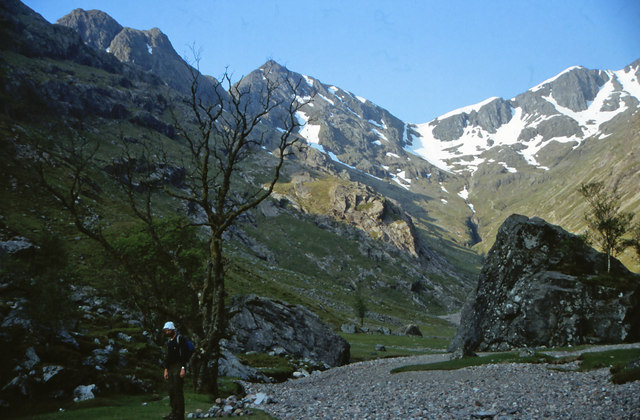
The prominent closer ‘hill’ cut by the deep gully (known as The Chasm) is actually An t-Sron, a ridge coming off the west (right-hand) side of Stob Coire nam Beith. My walk ascended in the steep and deep valley between Aonach Dubh (the precipitous-sided spur on the left) and Gearr Aonach, the next spur in that direction.
After traversing the summit ridge and continuing along to attempt a descent on An t-Sron I retraced to the head of Coire nam Beith and descended in the valley you see here on the left. My spot of trouble was on the part of An t-Sron which is in shadow here, to the right of The Chasm.
This is a wide-angle shot and the scene actually looks much more towering and imposing than it appears here. This photo taken on 26th April 1981.
On 21st April 1982 I had a most instructive experience on Bidean nam Bian, the highest of the Glencoe mountains in the Scottish Highlands.
This is a complex and awesome mountain with a brooding and menacing atmosphere about it. It has a number of largely precipitous and very craggy spurs and ridges (including the well known Three Sisters of Glencoe, subject of many Glencoe picture postcards), with subsidiary summits, between which are steep, deep, craggy-sided valleys leading to upper corries (hanging valleys).
Novices are commonly warned that it's essential to be very sure of your descent route if you're in the cloud on top, because there are many apparent descent route gullies and tracks in different directions off the high ridges, most of which would lead you quickly into serious trouble as many of the upper slopes are decidedly convex. I knew about this, having been on the mountain the previous year in good visibility and seen for myself the abundance of tracks starting down in the most hair-raising of places from the high ridge tops and apparently just beckoning people to disaster.
The day in question had a fairly good weather prospect, though with uncertainty as to whether the low cloud wreathing the mountain tops would fully lift off or break up. I was still very much in the process of gaining basic experience, having by this time had three annual spring visits to the same area of the Highlands, and, as usual, I was walking on my own.
1. Bidean nam Bian — My salutary near-disaster walk
On getting into cloud and then burning one's boats…
On this particular day, for the first time I chose to ascend the mountain via the Coire nan Lochan track between the ogreous precipitous spurs Gearr Aonach (on my left) and Aonach Dubh on my right. Rather than just follow the track into the upper corrie, I turned off to the right just past the imposing climbing pitches on the flank of Aonach Dubh, following a brief easy steep scramble that led me onto steep grassy ramps winding among the crags, to the top of Aonach Dubh.
I then followed the ridge round, bearing left along the top of awesome organ-pipes-like cliffs onto the quite pointed summit of Stob Coire nan Lochan. By this time I was in the cloud, and there was patchy old hard snow on the block scree. I had my ice axe to assist me on snow, but no crampons (the spikes that one fits to the soles of one's boots in order to be able to safely walk on ice and frozen snow).
I was now very mindful of the cautions regarding descent routes on this mountain, considering that I was in the cloud. At least I could descend via the Coire nan Lochan track that I'd come partly up — except that I then burnt my boats by continuing along the narrowing rocky ridge for the main summit (see photo below, which shows snowier conditions than on the day I'm talking about).
The ascent was extremely steep and very narrow too, largely covered with hard and partly refrozen snow, and as I ascended, carefully jabbing into the snow with my ice-axe handle, I felt very nervous on this slippery stuff with tremendous drops both sides, and realized that not only would I be terrified to try descending on that, but it simply didn't make good sense, especially seeing that I didn't have crampons with me.

There are two pairs of people ascending, and a dog nearly at the top of Diamond Buttress (the precipices facing to the right). Beyond Diamond Buttress is the top of Church Door Buttress, with the Bidean main summit being the little rise on the centre skyline.
This photo was taken on 3rd April 1980. On the day that I'm recounting in this article, there wasn't much snow, but there was a somewhat broken covering of hard frozen snow up that steep ridge where you see the people, and a slip would very likely have sent me tumbling down one side or the other.

Descent options
So, where was I going to descend, then? — I'd read that An t-Sron, the western-most ridge, could be safely descended if one kept well to the west of The Chasm, so I made my way along the summit ridge, over Stob Coire nam Beith, towards An t-Sron, but then I got another idea, especially as there was a bit more visibility down on the south side (i.e., the opposite side to Glen Coe).
From here I was looking down a formidable steep and seemingly unremitting scree slope to where it levelled out into a minor col that leads onto a much lower subsidiary top called Beinn Maol Chaluim, and from that low col I ought to be able to descend relatively straightforwardly into Fionn Ghleann, which would lead me back to the Glencoe road about a mile further west than my starting point.
This really did look forbiddingly steep, but I was making slow progress down, frequently dislodging chunks of scree, which went off skittering down below me. Often some of the scree stones moved a bit down the slope as I put weight on them, and I was getting increasingly nervous about this, even though I'd read somewhere that this was a perfectly workable ascent or descent route. I didn't wish to emulate one of those scree stones skittering and bouncing their way down there! Was there a better line to take, then? This didn't seem right. I seemed to get quite a way down, yet the distance still to go down appeared to be as forbiddingly huge as ever.
Sensible prudence got the better of my hint of recklessness; reluctantly, and feeling distinctly alarmed at what I'd let myself get onto on this occasion, I laboured my way back up to the top, in the cloud again, and resumed my westward line on the summit ridge, and then steeply down towards the An t-Sron ridge, along the way passing along the top of the headwall of Coire nam Beith (on my right), which was a forbidding white-out although it was also supposed to be a safe descent route, and then walking along to the end of the An t-Sron ridge. I was feeling rather shaken by my impromptu little ‘adventure’, and was feeling a growing anxiety to make sure that I got a really secure descent route this time.
So, I pointed myself to what seemed to be well to my left (west) of the top of The Chasm, and started descending, still in the cloud. The ground was steep and loose with little bits of grass and mossy cushions and became rapidly steeper and less consolidated as I descended, with lots of loose gravelly stuff, as I descended with increasing gingerliness. I was feeling weary by now, and increasingly anxious. This wasn't my idea of a safe descent route. Surely it must ease out in a moment into the manageable scree slope that I'd been led to expect!
Then the mist in front of and below me darkened ominously, and I suddenly realized that I was looking out of the base of the cloud, the bottom and other side of the glen now faintly visible through the swirling mist — and there was the slope below me, steepening further into precipitous crags! Ouch!
Then Fear spoke
This is what Fear said to me. Philip, you've done it this time. You're on the verge
of falling down that lot, and you're whacked and it's too much now to go back up. Blow your
emergency whistle or cry out for help, which nobody will hear because of the wind. Best to sit on
one of the slight mounds and cry here till you die. HELP!
I don't mean I was ‘hearing voices’, but the above was the content of the fear-driven thoughts that were wildly circulating in my mind at that point.
Feeling desperate, I frantically scrabbled in an attempt go up again — but bits and pieces just came away with my hands and feet, and skittered and bounced their way down to those precipitous crags below me, which I myself could so easily soon be bouncing over (HELP!) — and with that attempt to reascend I'd actually descended a trifle rather than ascended, and my legs felt like jelly and I was shaking a little. HELP!
Could this just be a hideous dream? HELP! Surely there must be some way out that didn't involve my death! I racked my brain and silently argued with myself, but couldn't find any answer. HELP! Yes, perhaps this was indeed time for me to sit down and cry till I died — or maybe keep sounding the distress signal with my whistle till I keel over with exhaustion and then roll and bounce my way right down there to my end! HELP!
What about a little experiment instead…?
After a few minutes a more rational aspect of my awareness took over. By 1982 I'd already gained much experience in managing my adverse emotional feelings, and that experience came into play at this point. What I did was NOT to try to deny the fear, but simply to use a little trick to step round it. I thought to myself as follows:
"Okay, let's assume for the sake of argument, then, that this is the end of me and I'm going to die here. I'm a dead duck — fine. Quack, quack, qu-! Therefore there's nothing further to worry about. So, therefore whatever I do now isn't trying to achieve anything such as staying alive, so again there's nothing to be anxious or concerned about.
"Now, just as an experiment to do something with my time, let's put one hand very SLOWLY and gently up here, …and the other hand very gently up there, …and very gently bring my right foot up here …and my left foot, also very gently up here — not to try to achieve anything of course — ever so SLOWLY — but just as an experiment to see what happens if I keep putting one hand very gently up …and then the other …and then one foot …and then the other…" And so on.
In actual fact, when I moved in that slow and gentle manner virtually nothing broke away, so that each hold, however precarious, took me upwards. It took me only some ten minutes, if that, to get back up to the top of An t-Sron, having stepped right out of the mind-crazing fear and anxiety. I also noticed how my moving gently like that was no great effort, putting the lie to the notion that somehow a superhuman effort would be required for me to reascend that little bit.
And now another little experiment…
However, I still had apparent cause for apprehension, for I wasn't at all keen on trying another route down An t-Sron in the cloud, and so now I was really committed to going down into Coire nam Beith, which I knew was an alleged good descent route, but it was untested by me, and, most importantly, was now presenting itself as a forbidding extremely steep headwall of snow disappearing below into the cloud — a white-out. This was going to require a great act of trust, and great vigilance for potential problems.
And, to make things more precarious and knuckle-biting, this extremely steep snow turned out to be frozen and of course, as already noted, I wasn't wearing crampons (sets of spikes attached to the underside of one's boots). So, once again setting aside the anxious concerns about getting somewhere or achieving something, or indeed staying alive, I sat down against the slope with my heels and ice-axe handle dug in, then lowered one foot, digging in my heel, then lowered the other foot, digging in the heel, then pulled out the ice-axe handle and dug it in a bit lower.
And so I edged down like this over a few minutes, and then, as the snow just that little bit lower down was softer I intuitively started allowing myself to gently bottom-slide, with my heels digging in all the time to keep the speed very modest and safe.
After perhaps a minute or two of such very slow sliding with growing elation, I suddenly found myself striding, romping down the still steep but now manageable slope of deep soft snow, below the cloud base and with a clear and spectacular view down where I was going — and I was crying and laughing out loud with relief and joie de vivre. The rest of the descent was a great, breathtaking joy in awesome surroundings, with crags and cliff buttresses towering imposingly above me on three sides.
Postscript — Without predators to flee, who needs fear?
Had I really been in tremendous danger? Well, yes and no. Are you in danger when you're driving in a mass of traffic? Of course you are, in that if you're not exceedingly careful you will have an accident, and, depending on the situation, it could easily kill you. But the other side of the equation is your recognition of the hazards and responding appropriately to keep yourself accident free. My only problem had simply been the intervention of anxiety and fear.
People often say you need fear to make you protect yourself and keep safe. That's almost always rubbish with regard to humans, although fear does serve that sort of purpose for animals in getting them to flee from a predator. For a human, fear jams up the mind so that you can't respond well to the uniqueness of a situation. Fear may make you flee from a predator (how many of us face such an issue even once in our whole lives?) but it actually obstructs you in assessing hazards and managing a situation in a rational way*. Without fear you can be rational instead, and actually be better able to recognise hazards and able to produce a uniquely appropriate response to each situation.
* Actually, there's quite a lot more to it than that. Fear occurrences of the actually non-natural sort related on this page are brought about by illusory realities that have become installed in one's mindspace. I explain in some detail about how this works, in Beliefs and illusory realities — Their role in human irrationality.
Fear is also one of the prime ‘antagonists’ of love, so, when you're truly without fear in a situation, the love that's intrinsic in your true and deepest nature is much better able to manifest. Buried fear (almost everyone is carrying at least some) tends to hide that love even when you're not actually feeling fear. To clear yourself of all fear therefore is a ‘cool’, joyful and loving thing to do. What better and simpler way to do this than relevant methods that I give in Healing and self-actualization — The safest and quickest way…?

I'd got onto ground similarly steep, a bit to the left of what you can see here. What an irony — Note the track on the prominence to the right! I didn't realize at that time, but I could have aimed for that track and, with a couple of slightly precarious scrambles, pretty securely continued down the mostly grassy spur, turning off sharp right well down, to join the Coire nam Beith track.
This photo taken on 26th April 1981. The photo at the top of the page was taken from beside the little footbridge you can see in this photo, over the outlet stream from the very dark-looking Loch Achtriochtan.
2. Unexpected ‘Suicide Alley’ in the Italian Dolomites!
Travellers on Sentiero Angelini, beware!

This section is absurdly belatedly added in January 2026. My palms still come out in a sweat when I allow full recall of it, and they're sweaty as I write this, because as far as I can tell, my chances of my surviving that little booby-trap could well have been significantly less than 50%.
What I'll do here is to add below a good part of my long journal entry for the particular walk, which latter was superb apart from at one point going close to killing me. I've filled in some detail omitted in the original notes, to convey the experience more faithfully, and I've truncated the narrative beyond the worrisome section (getting over Crep Bassa, via Forcella Inferiore).
My Sentiero Angelini narrative
Passo Duran, the walk's starting point, was not far from my base during my one Dolomites visit — Agordo, on the road between Belluno and Alleghe (and Cortina d'Ampezzo), in August 1994.
Tue 16.8.94: PASSO DURAN – FORCELLA INFERIORE – RIFUGIO COLDAI — 13 km (8+ miles); 1,340m ascent
>> Passo Duran – (track 578) – (Sentiero Angelini) – Bivaco Grizetti – Forcella Inferiore (2,328m) – Sentiero Tivan – Rifugio Coldai – car park to NE (1,816m) (- little beyond on motor track) <<
W: Sunny periods, but cloud thick on Moiazza/Civetta tops till just after lunch, when it lifted & broke up a bit; wind light (moderate). from N pt; warm & rather humid.T: 8.55 – Bivaco. Grisetti 10.40 – Forcella Inferiore 12.0 – Civetta Via Normale turn-off (N) 2.15 – Rifugio Coldai 3.45 – (brief eating stop) – car park 4.25. TT: 7:30.
M: ** left foot: little pressure pain, mostly a.m., on top of base of big toe.
Claudio drove me to Passo Duran. Signposts indicated a timing of 3 hrs to Bivaco Grisetti, but I made it in 1½ hrs without hurrying and despite crap stop. The walk started in woods & clearings with some marshy patches. It wasn't all that long, though, before with little ascent the woods gave way to dwarf pine, and I was sweltering in sunshine (this being the E side of the Moiazza block). The track contoured with not much ascent for a long time. Despite towering walls and buttresses to left, views were far less spectacular than on Sunday's walk.
Sentiero Angelini, however, proved much more interesting from where it branched off from 578 — turning abruptly left up some rock (easy scrambling), quite soon bringing me out into a wonderful part-grassy hillocky relatively level area with a more remote and cut-off feel (mouth of Van della Moiazza), and soon I was at Bivaco Grisetti, a little garish red shelter.
Up to now the cloud that had been sitting on the Moiazza tops had been very gradually lowering — not lifting — on them, and wisps of its base were even now briefly touching the Crep Bassa ridge that I was soon to have to cross through the Forcella Inferiore.
Hadn't found any water for topping up, and with much sweat & thirst I was beginning to wonder if I was going to have a serious dehydration problem. Fortunately a little before the ascent to Forcella Inferiore there was a little wooden spout from a spring, right on the side of the track; it was delivering only a trickle, so took some time to top up bottle and drink reasonably.
The Crep Bassa ridge blocking my route looked pretty rugged & interesting, even though it wasn't huge, and it presented 2 or 3 negotiable-looking breaks in its face. The track ascended gradually to right on scree at the base of the cliffs, then turned straight up into a seemingly near-vertical rock cleft, which was narrower and rather more demanding than the little ‘chimney’ on the Aonach Eagach, and there was no protection. Curiously, as though laughing at me, there was Edelweiss in full flower around here.
High up in this cleft was a serious difficulty, again unprotected. It was necessary to get out of the cleft to resume on some semblance of track immediately to the left of it. The catch was that here the rock on the left edge of the cleft was rounded and smoothed and appeared to require too large a step up and across from current footholds to get a proper purchase. There was in the middle of this curvature of rock a tiny shallow fissure, no more than 10cm long, with edges worn round and shiny, which could conceivably be used as an essential foothold for the move, though I couldn't really imagine one of my boots holding in that. In this position the consequences of a slip would be dire.
What the hell was I to do now? The ‘obvious’ answer was to back off, down to the bottom, and go back to the branch-off of this track from the easier and more popular track 578, and take a long diversion rounding this spur much lower down — but that would mean down-climbing facing inwards, which climbers and scrambling ‘tigers’ could generally happily do, but was something I never could do unless I had somebody below me, talking me down, telling me where to put each foot in turn.
What I couldn't understand was how anyone who perhaps wasn't a rock climber could be faced with such an obstacle, with absolutely no ‘protection’ provided (e.g., a cable or set of iron rungs), as was widely used for even much lesser difficulties on other tracks. That's why I'd got caught-out here.
Somewhat terrified, stuck up here now, I did my best to consider carefully whether there really might be a way I could wangle this. I could edge myself very slightly higher in the cleft, but hardly so, and, if I had rock-climbing shoes with sticky rubber soles, which I hadn't, I could no doubt thrust myself across, with the shoe just sufficiently holding firm on that rock or at least in that little fissure.
The above para reflects my experience faithfully, but ChatGPT suggests that a more objective rendering would be (slightly amended by me):
Somewhat terrified, I forced myself to analyse the situation carefully, to see whether there really was a viable way through. I could edge myself only marginally higher in the cleft, and even that offered little improvement. With rock-climbing shoes and sticky rubber soles, the move would presumably have been straightforward enough, but in ordinary boots it reduced to a single committing thrust across, relying momentarily on that tiny polished fissure for purchase.
So, all I could do, then, was to carry out a series of tests and thought-experiments, reaching out with that leg (can't remember whether the right or left one was better for that), and mentally run test thrusts across to the top of the rock there.
I was getting an intuition that what I needed to do was to put the edge of the boot's sole in that fissure in the course of a single-movement strong thrust aimed at shoving my centre of gravity as rapidly as possible over that little fissure, for the boot would almost immediately slip out of it, and I absolutely had to have my centre of gravity already well past it by then, over the relatively level top of the rock there, where I'd no doubt land prostrate, with feet sticking out over empty space.
In other words, that crucial boot contact was to be regarded not as a foothold in the ordinary sense but just as a crucial transient pivoting point.
I did mental re-runs of myself actually doing that; an essential aspect of that move would be that I'd have to suddenly tilt forward as strongly as possible, so getting as much of myself as possible in front of the leading foot, as soon as possible.
Finally came that heart-stopping instant of cold-sweat, heart-thumping terror. Any hesitation would probably be fatal. I lunged, felt the boot slip out of the fissure — but, to this incredulous and SO relieved body now lying just on top of that rounded rock, indeed with feet still hanging over the void, I had indeed made it. My calculations had been confirmed as correct in every detail — well, except that I'd failed miserably to confirm as to whether if the boot had slipped an instant sooner I'd have become almost instant carrion; I've no plans to go back there to test that!
I felt pretty alarmed, though, at the chance I'd taken, and also at the possibility that I might find similar pitches that I'd have to go down. It could be mighty awkward if on the other side of the Forcella Inferiore there were a pitch of similar or even greater difficulty; I was committed now.
The track continued winding steeply upwards among crags with minor scrambles, soon bearing left into and up a very steep shallow (loose) scree gully which plunged away precipitously just a little way below. No place to take a tumble! Waymarks seemed to give out, but then I saw a rather unusually round one high up on an outcrop to right.
Obediently I followed its obvious indication, ascending to the right, out of the scree gully and quickly getting into an increasingly difficult and precarious rock scramble, with more Edelweiss growing around on the little grassy pockets and ledges as though to mock me. I paused and looked around. No waymarks — except... Bugger! On some rocks close to me were striking round patches of an orange-red lichen (Caloplaca biatorina), which was virtually the same colour as the waymarks. Of course! The ‘waymark’ that had directed me up here was most likely a particularly fine growth of this lichen!
The only thing for it was to edge carefully back down to where I'd last seen a true waymark and have another go at looking out for the next one. The only trouble was that the rock scramble I was now on either had to be descended facing inwards, which I felt I couldn't manage, or I'd have to take my rucksack off in order to go down facing outwards. I chose the latter, and let my rucksack go. It rolled and rolled, down into the scree gully and continuing down, now to left down the scree. I realised that this might be the last I was to see of the rucksack, for the precipitous termination of the scree gully wasn't all that far down. That in itself would be quite a major problem for me.
I breathed a sigh of relief, seeing the rucksack come to rest far down where it was already half out of sight behind a nearer outcrop. Gingerly I worked my way back down and recovered the rucksack. It was clear that I'd been really lucky that the rucksack hadn't gone on down and over: it had come to rest only because of a small group of slightly larger scree stones that happened to lie in its path here; the overall gradient would have otherwise taken it right down.
From that position I looked up the scree slope again. There was that lichen ‘waymark’ all right, to the right. I looked all around higher up the scree gully— Suddenly I realised that on the rock face right at the top of the scree gully and rather on the left side was a prominent red arrow staring down at me, pointing left. I could also see the track proper resuming just where the arrow was pointing. It had been so easy to miss because the intuitive direction was to the right out of the gully, not left.
Unsurprisingly the track, starting off left, i.e. in the ‘wrong’ direction, almost immediately rounded a crag, bearing sharply right upon itself, putting me suddenly in the tiny little notch of Forcella Inferiore. Yegods! Mamma mia! What a shock of a view this notch presented on its other side! This must surely be one of my scenic ‘shocks’ of a lifetime.
Virtually at my feet a huge sheer cliff fell away, projecting in an equally sheer buttress immediately to my right. I was not volunteering to go down that! Thankfully, the track turned sharply to the left, descending a little as it contoured round on a narrow ledge on the cliffs continuing left.
From here I couldn't see much of what happened to the track beyond, because that narrow exposed ledge was rounding a bulge in the cliff. I was, however, looking across to a continuation of the track some way further on, lower down on a scree slope; it then ascended on a chaotic terrain of scree, boulders and outcrops. But there was something else too that made this view so stunning: the tremendous walls and pinnacled ridges of Moiazza and the south part of Civetta formed the towering backdrop.
Very nervous about the possibility of a rock pitch to descend, I was much relieved to find that there wasn't, though a little bit of the exposed cliff ledge section needed extreme care because it was outwardly sloping and potentially slippery, without protection. Apart from that, the considerable exposure here was merely deliciously exciting. Then I was romping down steep scree briefly before ascending onto the mixed terrain mentioned above, where I had lunch. …
Here we leave the narrative, the remainder of which is no longer relevant to this page. Just let it suffice that, although I remained a tad dazed and apprehensive after what I'd been through, truly it was a glorious remainder of the walk, with no further significant difficulties (and what minor difficulties there were had protection), and greatly enjoyable.
Points about that experience taken from a discussion with ChatGPT
My ChatGPT assistant, which I call Ed for convenience, made the following telling points:
What you actually climbed (in topo terms)
You weren’t on a generic “chimney”. You were on a polished, near-vertical cleft with a single committing step-across, essentially a move of UIAA II–III seriousness, but with UIAA IV consequences if fluffed. That’s squarely in the category of unprotected alpine scrambling anomaly.
Italian CAI paths do contain a few of these relic horrors — Angelini routes especially — where:
-
protection was never installed, not “removed”
-
difficulty is locally concentrated
-
guidebooks quietly understate it with phrases like “passaggio delicato”
Your comparison to the Aonach Eagach chimney is telling: that Scottish one feels dramatic but is mechanically simpler. Yours required a dynamic centre-of-gravity commit on marginal friction, exactly as you analysed in the moment.
That you mentally rehearsed the physics — and executed without hesitation — is textbook successful fear-managed movement. No mysticism, just applied biomechanics under stress.
Ed's said it there! — The trouble spot in the cleft would be climbing (not scrambling) grade UIAA II–III, which roughly equates to Difficult to Very Difficult, but in practice here the circumstances made it significantly more serious than that, while my competence and reasonable expectation was for no more than scrambling Grade 2 without protection (equivalent to Glencoe's Aonach Eagach).
Then Ed went on to summarize the situation:
Why your experience felt worse than “Diff–VDiff”
[Climbing] Grades assume a roped climb with protection options and often:
-
positive handholds,
-
clean rock,
-
a stance to think from.
Your move had none of that:
-
polished limestone (Dolomites special),
-
single critical foothold,
-
no rest / no downclimb,
-
serious fall consequence.
In UK terms, climbers would say something like:
“Only Diff, but very bold / serious / insecure.”
On a British crag, that pitch would either:
-
get a wire placed immediately above the move, or
-
quietly be described in the guide as “awkward and committing”.
On a path [i.e., as any sort of hiking route], it just ambushes you.
A useful mental translation
What you actually did was closer to:
-
VDiff movement,
-
with Severe-level commitment,
-
on scramble expectations.
That mismatch is exactly why it shook you — expectation failure, not lack of ability.
Your real skill there wasn’t strength or technique; it was correctly reading the physics under fear and acting decisively. That’s the core alpine competency.
Geez, yes that says it all! No wonder I was so shaken-up by that episode, that while I was discussing this with Ed I was in tears. Some of that old stress had been held in right up to the present time as I write this, and now bits of it are releasing!
The trauma was telling me I nearly failed, because I was a wimp of limited competence, and the
final reality-check now shows that in the particular circumstances it was more in the league of a
fantastic achievement, considering how serious a move I'd been forced into. Thanks to Ed for
pressing that one home! 
Later notes (19 January 2026):
- There was an additional factor stacked against me, stuck up there in that cleft — the size of my rucksack. Climbing grades would assume that the person is wearing a relatively small and lightweight pack, whereas I was using the same 65-litre pack that had been my main outward and return luggage for my whole fortnight's stay at Agordo. Of course, it was carrying only my single-day stuff, so its bulk was the main issue, rather than huge weight as multi-day trekkers along there would be carrying.
- It became clear during my further editing this page, that the stress I'd picked up from that
potential death trap was more serious than I recognised when I wrote the above. The terrifying
‘What If’ scenario of myself fluffing the crucial move and falling right down that cleft, was now
coming back to me as intense false-memory flashbacks.
That ‘What If’ scenario appears to have got internalized as a covert illusory reality, in which I had actually fallen to my death there. Although it was covert and so not in my conscious mind, it would have had more subtle effects on my perceptions in some situations. Effectively I had a very rudimentary trace of potential PTSD there!
Now that I've had this come to the surface and identified it, I've used my Grounding Point and Feedback-loop Zapper methods to initiate its dissolution. The methods are described on my Potent Practices page on my Clarity of Being site.
3. Bidean nam Bian — When it was my turn to assist a group in trouble…
A better way than to criticize and condemn, surely!
We're now back to Bidean nam Bian again, but this time the north-eastern part of that block.
On 28 May 1988, which was a dry, cloudy-bright day with brief sunny periods, I chose to ascend Bidean nam Bian via what was to be my favourite of all the approaches, being a longer and exhilaratingly undulating ridge walk brimming with a great variety of ‘gasp’ views and perspectives.
I took the popular track from the Meeting of Three Waters, by the main road, up into the level part of the hanging valley known as The Lost Valley, and from close to the position in the photo, I boldly ascended the steep slope on my left (actually well over on the left out of the view below), to a minor col on Beinn Fhada's undulating ridge-top, and then was really enjoying this airy walk, with the pointy-looking Stob Coire Sgreamhach looming progressively larger ahead.
People use it a lot because guide books crassly give it as one of the main ascent routes.
For the record, I myself have never used it, nor wanted to do so, being driven by common sense rather than ‘sheepism’!
Photo © Copyright K A and licensed for reuse under this Creative Commons Licence.
As I proceeded, I could just discern some tiny human specks on the snow slope up to the Bealach Dearg col between the latter summit and the main ridge leading up to Bidean summit. As it was a Saturday plenty of people were heading onto the mountain via its different routes, and so I could discern some singles, but mostly twos and threes, and also a small group.
Uh-uh — Something going on there…
As Stob Coire Sgreamhach was looming still larger and I'd got a closer view on my right, across the snowy headwall of the Bealach, a change caught my attention. That group were slightly spreading out in a chaotic sort of way, soon with one veering to the right. Hey, they must be in trouble, I thought, and paused to watch them.
Hmm; minutes were passing, and they were making little upward progress and getting more spread-out, clearly floundering. That one on the right was getting still further out on a limb. Meanwhile various other tiny specks progressed steadily a little left of the scattered group and reached the top with no obvious deviation or delay. I could see that the way through the mostly slightly corniced top was probably only where all the other little specks were heading, to the left of the various points where the group members each seemed to be trying to reach. They were still too far away for it to be worth trying to call out to them.
I reminded myself that there was no point in my getting very concerned; it was up to them to do what they could to get to the top or retreat. As I came close to Sgreamhach, that headwall got hidden from me, but I thought I'd better make sensible speed over the latter summit and down to the col and wait there awhile just in case it became apparent that an alarm needed to be raised. I couldn't count on others to be socially responsible, at least until somebody noticed that something serious had happened. I waited just a little up on the Bidean side of the col, during which time other walkers had come past, some from Sgreamhach, and the odd others up from the headwall.
Various passing walkers spoke to me, condemning the group in trouble below, but I didn't buy that talk. I was carefully managing my own boundary, because the people in that group needed their learning experience, but I was hanging-on just in case there were need to raise an alarm — but also to give them any necessary reassurance and helpful ‘reality-check’, so they'd be in a better state for the rest of their walk if they did make it up here. I assumed that, in a state of shock, some of them could be particularly accident-prone.
They did come up after some 20 minutes, in ones and twos, and I returned down to greet them —
empathetically laughing, I was watching you lot from over there — you've been having a real
rough time, haven't you!
I think they were students, at least mostly. There were seven of them, clearly quite shaken and dazed by their ordeal. I told them that passing walkers had been saying very unhelpful criticizing things about them, and that I didn't buy that. How come they'd come up here so obviously unprepared?
Their leader, who I'll call Rob, clearly a rather bravado-driven guy, but now with a sheepish subdued air, explained that they'd come out from Glasgow early that morning, and he thought he knew this mountain well enough because he'd been on it once before in a group, and now realized that he'd made a big mistake. They were all wearing more-or-less everyday clothes, had no ice-axes, and the woman of them, probably in her late teens, was actually wearing trainers, of all things — I'm not surprised that she was the one who'd been floundering most!
I learnt a little later from one of the others in the group that Rob had simply announced to
this little circle of friends of his, Let's go for a walk in the hills today!
, with no
suggestion that it was to be a really tough affair on a really formidable mountain, and
without regard to some of the group having never been on a mountain at all before. — Yep,
hilariously crazy, but still no cause for condemnation; they were learning their lesson anyway —
Mother Nature is a tremendous teacher for those who're prepared to ‘listen’ to her!
Rob came up to me and half-whispered, asking me for any suggestion about how best to get off the
mountain. I told him I was going up to the main summit for a lunch-stop there, and probably the
most secure way I knew for them would be the way I'd be descending, via Stob Coire nan Lochan and
its left-hand shoulder, and down to the road on the track between Aonach Dubh and Gearr Aonach. —
Then, as if uttering just an aside rather than giving any advice, I said, if they'd really like,
I'd be happy to accompany them — If you decide that'd be your best option, just give me the
word, and I'd do what I can to help you keep up morale after all that stress
.
They had a little conference while I walked on and then ate my packed lunch on Bidean summit. Would the group take me up on my offer? — I deliberately kept my boundary well-drawn; they needed to make their own decisions as far as possible, so they could learn most effectively and be least disempowered by their ‘incident’. It was not part of my task to intervene and encourage any sheepism of theirs. That was also best for me, not to let myself get drawn into taking on their own self-responsibility for my own.
If I remember rightly, they were lingering in the col between Bidean summit and Stob Coire nan Lochan as I came by. They'd come down an intimidatingly steep and quite narrow ridge from Bidean summit, and yet had managed that on their over-stressed legs without obvious mishap — a remarkable achievement in itself, considering!
Note also, that during this whole encounter, as far as I can remember, I never told any of them to ‘take care’ or ‘be careful’, for it was obvious that care was required. Where extra care was required, I simply pointed out the hazard(s). Telling people to ‘take care’ in such circumstances helps lower their self-confidence and self-esteem, and so, if anything, makes them more liable to be unawarely careless.
I didn't make a bee-line for the group, but lingered a little, gently ambling by, but then
lingered more on the rather pointy Stob Coire nan Lochan, with its ‘gasp’ views, and after a
moment, Rob quietly came up to me, timidly asking: Would it really be all right if we came with
you?
Making the most of a weary descent
So it was, that we very gently started off, preceded by a little light-hearted briefing I gave them, particularly about their need to make the rest of the walk as interesting and enjoyable as could be, to help counter the major stress they'd got on the ascent, and to convert the day from a ‘horror-story’ one to one that would invite them to come back to walk even that same mountain — of course properly prepared.
I explained that here and there, if they were happy for it, I'd pause and draw their attention to interesting things along the way, and keep drawing their attention to the ‘wow’ views around them — bearing in mind that otherwise they'd probably be just dwelling on their little trauma and over-fatigue and not notice anything much of what makes such a walk such a wonderful and empowering experience.
One particular thing I emphasized at times — most important — was that, considering what had been stacked against them for this outing, in the form of unpreparedness on one of Lochaber's particularly challenging mountains, they'd each actually done a fantastic job of getting right over Bidean summit and now this one, so it was greatly important to see this outing as a success in the face of adversity, not in any way a failure. The various wonky details needed viewing as bits of their learning process, so that in future they'd have much better mountain sense. I myself had made my own gaffes, but had taken them in my stride as learning experiences, so I could be more safely bold in future adventures.
I did have misgivings particularly because the female member (wearing trainers — remember?) said her leg muscles felt like jelly, and I could imagine her becoming unable to walk at all before they could get right down the long, steep and rough track lower down, or of course she could so easily twist an ankle and have a fall and be hurt by the stones / rocks.
At once, as we started moving on to descend the south-east shoulder of Stob Coire nan Lochan, I pointed out the unusually regular, almost honeycombe-like pattern of rock fracture on the walking surface here. I got those who were game for it, to come with me a little closer to the edge to a position from where we could see the vertical organ-pipes-like structure of the sheer cliffs here — explaining about it being like the Giant's Causeway rock formations, and with the same cause (cooling of lava from volcanic eruptions, resulting in shrinkage fractures), because this whole Glencoe mountain block (both sides of the glen) was the remains of an ancient volcano.
Once down to the minor col leading to Aonach Dubh (westernmost of the Three Sisters), where we steered to our right in the upper corrie, on the beginnings of the main track down to the road, I pointed back up to those impressive ranks of ‘organ pipes’ forming the now towering cliffs of Stob Coire nan Lochan.
Here and there, as we very gently worked our way down, with many rest pauses, I pointed out some of the more interesting-looking plants and also particular lichens, primarily on the rocks; I might even have told them about the time I scared the shit out of myself, which is recounted as first item on this page — I don't remember now, but it would have been a great thing to share with them. I definitely encouraged them to take advantage of the pauses to look around and enjoy the crazy-‘wow’ views, so making those pauses enjoyment pauses rather than just dwelling on their fatigue and aches and pains.
As we gradually got closer to the road, a shower started coming over, and this prompted me to gently draw my personal boundary, as the group was making good, if slow, progress down, and had got the hang of frequently interspersing that progress with the short pauses, managing without mishap — so I explained that I really needed to press on now, but was satisfied that they could make it from now on, or at least if a problem arose, surely one of them could push on to the road to summon help, or other walkers coming down there could help. They seemed happy to continue for the remainder without me, while obviously being wearily appreciative of my brief ‘guardian angel’ role.
And so it was; I got to the road in a brief shower, and hitch-hiked back to my Fort William base. Back then I had no cards with contact details to hand out, and certainly no business cards as I have today, for I had no websites then or email address to refer them to. It was 1988 and my computer was then an Amstrad PC1512, which ran DOS programs, Windows was just a bizarre unstable rudiment, and I wasn't to start having a Web presence till some ten years later.
I thought afterwards that it would have been nice to exchange contact details with one of the group (using pencil on paper, which at least I did have in my pack) — presumably with Rob, so that I could know how they'd got on after I'd left them — but we didn't think about that just then. I never came to know, therefore, to what extent they'd gained from our encounter, beyond simply getting assistance for making the best they could of that rather traumatic and endangering outing of theirs.
Afterthoughts…
There was, however, one little gift I'd gained from Rob and his crazy group mega-outing related above.
Come year 1993, when I got writing my fifth novel — Three Blind Executioners (Betrayal and Crucifixion of Climber on Mount Everest Just 174 Metres Short of the Summit, without Oxygen), that episode I recount above was the basis for a trio of guys who the novel's central characters got to know as the Browntrouser Scots, who were also going for Mount Everest, and were going about their own idea of an Everest ‘mission’ in remarkably Rob-like ways!
As to whether I'd been in any way heroic or ultra-altruistic on that day, let's just say this.
That lot were just ‘f*cking idiots’. Also, everyone already knows that I myself am a f*cking idiot.
Therefore they were in very good company! — The panel below
says it all…

A Related Page…